


Beyond “Reactor + Centrifuge” for Safer, Smarter, and More Profitable Operations
What if the biggest bottleneck in one of the world’s most essential chemical processes wasn’t a lack of raw materials or market demand, but a simple, persistent design flaw?
Consider glyphosate. As the world’s most widely used herbicide, it’s a pillar of modern agriculture. Yet, for decades, its core production has followed a strangely fragmented path: chemicals react in one vessel, only to be pumped to a separate centrifuge or filter press for solid-liquid separation.
This “react here, separate there” approach isn’t just inefficient—it’s a direct drain on profit, safety, and sustainability.
Why Multi-Step Glyphosate Systems Lose Efficiency
- Operational inefficiency: Manual transfers, batch handling, and idle waiting slow throughput.
- Product loss: Conventional filters let ultrafine particles escape, causing up to 5% loss of glyphosate chemicals.
- Safety and environmental risks: Open slurry handling increases emissions, raising concerns about how to reduce glyphosate exposure for operators.
- High overhead: Multiple machines demand more space, energy, and maintenance.
These challenges are accepted as part of the industry, but they don’t have to be.
Introducing the Integrated Solution: React, Filter, Deliver—All in One
At Dongou Microfiltration, we asked: Why separate what belongs together?
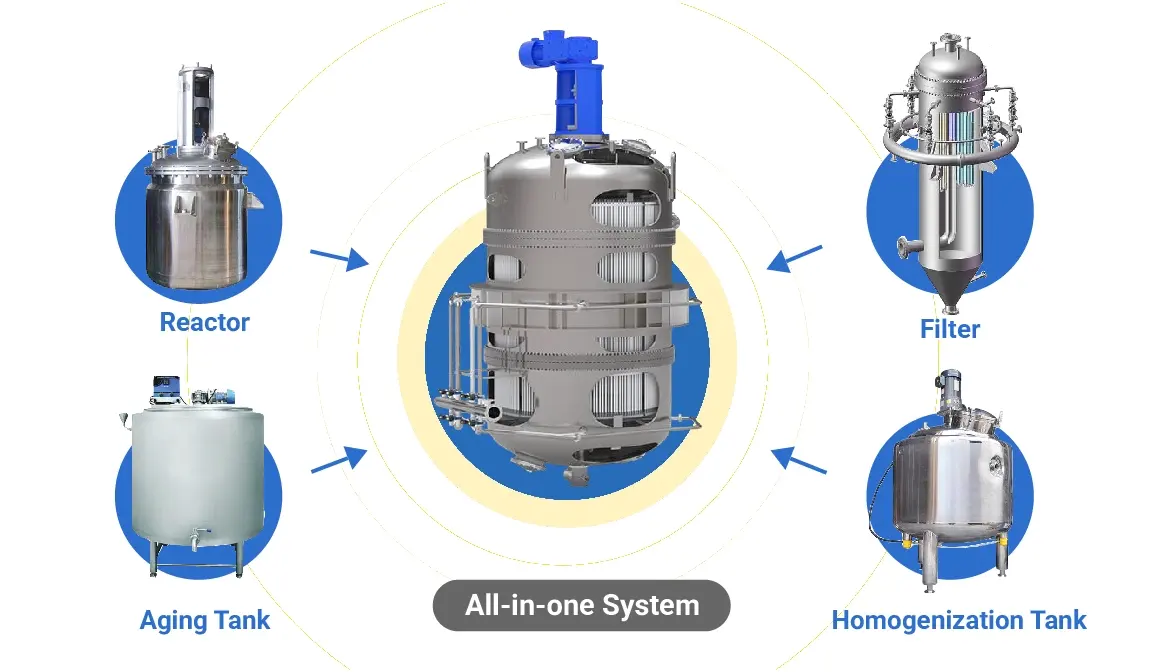
Our patented Glyphosate All-in-One Reactor Filter consolidates the full workflow within a single sealed vessel:
- Controlled Reaction: Precise temperature and pressure for consistent product quality.
- Precision Filtration: 0.2-micron filtration captures ultrafine solids.
- In-place Cake Washing & Drying: ideal for technical-grade material and glyphosate raw materials purification.
- Bubble-Assisted Discharge: Filter cake is moved without opening the vessel.
Key Advantages at a Glance
- Containment = Safety & ESG: A fully closed system eliminates fugitive emissions and operator exposure.
- Continuity = Efficiency: Batch times are slashed, and labor-intensive steps are automated.
- Precision = Yield: Every gram of product is captured where it forms.
| Metric | Traditional (12 Centrifuges) | Dongou All-in-One (6 Units) | Impact |
| Filtration Yield | ~95% | ≥99.99% | Near-zero product loss |
| Annual Product Loss | ¥10M (~$1.39M) | ¥0.02M (~$2.8k) | Recover ~¥9.98M (~$1.38M) |
| Energy & Maintenance | ¥3M (~$0.42M) | ¥1M (~$0.14M) | Save ~¥2M (~$0.28M) |
| Process Type | Open, batch, multi-step | Closed, continuous, integrated | Safer, automated, greener |
Interpretation: For a 10,000-ton-per-year facility, adopting All-in-One recovers nearly $1.38M in lost product and cuts OPEX by two-thirds annually. The system doesn’t just save money—it sets a new baseline for efficiency and profitability.
Beyond a Machine: A Philosophy of Integrated Processing
The All-in-One Reactor Filter embodies Dongou Microfiltration’s core belief: integration drives performance. By removing artificial barriers between reaction and separation, we reduce waste, cost, and risk, while delivering guaranteed quality.
Questions We Hear from Operators & Engineers
- How do we recover more active ingredient glyphosate without increasing operator exposure?
- Which filtration system can reliably separate ultrafine glyphosate powder with less downtime?
- How do we transition from batch to continuous production without reengineering the entire plant?
This integrated system answers these questions by design, not just by promise.
Next Steps
Is your glyphosate process constrained by split steps? Are you ready to move beyond “reactor + centrifuge”?
Contact Us to learn how the All-in-One philosophy can solve your filtration, washing, and drying challenges—delivering a safer, smarter, and more profitable production line.